
The Oil Shockwave: Navigating Soaring Textile Raw Material Costs in 2026
Date: March 23, 2026
Category: Supply Chain Insights / Procurement Strategy
The global textile industry is once again feeling the tremors of a volatile energy market. As of early 2026, a sharp surge in crude oil prices has triggered a domino effect, sending shockwaves through the entire supply chain and causing raw material costs to skyrocket. For textile procurement buyers, this is not just a blip on the radar; it is a structural shift that demands immediate strategic adaptation.
This article analyzes the current landscape, identifies critical procurement risks, offers a forecast for the coming months, and provides actionable strategies to safeguard your supply chain.
The Mechanism: From Barrel to Fiber
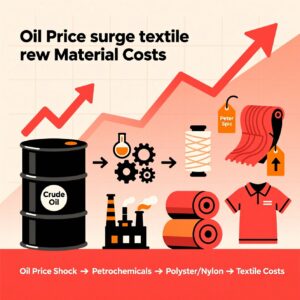
The correlation between crude oil and textile raw materials remains undeniable, particularly for synthetic fibers which constitute a massive portion of the global textile mix.
- Synthetic Fibers (Polyester, Nylon, Acrylic): These are petrochemical derivatives. When crude oil prices rise, the cost of Purified Terephthalic Acid (PTA) and Monoethylene Glycol (MEG)—the key building blocks of polyester—increases almost immediately. Recent market data from March 2026 indicates that polyester prices have surged by over 15-20% in just a few weeks, with some specific grades seeing hikes of more than 3,000 yuan per ton in the Asian market.
- Cotton and Natural Fibers: While not directly derived from oil, cotton prices are indirectly affected. Higher oil prices inflate the cost of fertilizers, pesticides, and fuel for harvesting and transportation. Furthermore, as synthetic alternatives become prohibitively expensive, demand shifts toward cotton, driving its price up through competitive pressure.
Critical Procurement Risk Points
In this high-volatility environment, textile buyers face several acute risks:
- Cost Pass-Through Failure: The speed of raw material increases often outpaces the ability of brands to pass these costs onto consumers. Buyers locked into fixed-price contracts with retailers while facing spot-market pricing from mills are seeing margins evaporate.
- Supply Chain Disruption: Volatility creates uncertainty. Some upstream chemical producers may curb production if refining margins become unfavorable, leading to unexpected shortages of PTA or MEG, causing production halts downstream.
- Inventory Valuation Risks: Holding large inventories purchased at lower prices might seem advantageous, but if the market corrects suddenly due to geopolitical de-escalation or demand destruction, companies could be left with devalued stock. Conversely, running lean inventories exposes buyers to immediate price spikes.
- Counterparty Risk: Smaller mills and dyeing factories with weak cash flows may struggle to purchase raw materials at current highs, leading to bankruptcy or inability to fulfill orders, disrupting delivery schedules.
Future Outlook: What Lies Ahead?
Forecasting the trajectory of oil and textile prices in 2026 involves analyzing conflicting signals:
- Short-Term (Q2 2026): Prices are likely to remain elevated and volatile. Geopolitical tensions and OPEC+ production policies continue to support high crude benchmarks. Expect polyester and nylon prices to stay firm, with potential for further incremental hikes if supply constraints tighten.
- Medium-Term (Late 2026 – 2027): There is a possibility of a “demand destruction” scenario. If raw material costs remain too high for too long, end-consumer demand for apparel may soften, forcing a correction. Additionally, some analysts predict a potential oversupply in the crude market later in the year as new产能 (production capacity) comes online, which could eventually alleviate pressure on fiber costs. However, relying on a price crash is a dangerous strategy.
- Structural Shift: We are likely seeing a long-term re-evaluation of material mix. The volatility accelerates the industry’s pivot toward recycled fibers (rPET) and bio-based alternatives, which may decouple slightly from crude oil fluctuations in the future.
Strategic Advice for Textile Buyers
To navigate this storm, procurement leaders must move from reactive buying to proactive risk management.
1. Diversify Your Material Mix
Do not rely solely on virgin synthetics. Accelerate the adoption of Recycled Polyester (rPET) and blended fabrics. While rPET prices also fluctuate, they often follow a different logic driven by bottle-grade PET waste availability rather than just crude oil. Explore bio-based fibers like lyocell or modal as stabilizing agents in your portfolio.
2. Implement Dynamic Hedging Strategies
For large-volume buyers, consider financial hedging instruments. While direct hedging of fiber is difficult, monitoring and hedging against Crude Oil or PTA futures can provide a financial offset to physical procurement costs. Work closely with your finance team to understand the feasibility of locking in prices for key commodities.
3. Strengthen Supplier Partnerships
Move away from transactional relationships. Engage in open-book costing with key suppliers. Understand their raw material exposure and work together to share the burden. Consider longer-term contracts with price adjustment clauses linked to a transparent index (e.g., CCIF or Platts) rather than fixed prices, ensuring fairness for both parties when markets swing wildly.
4. Optimize Inventory with “Just-in-Case” Logic
The traditional “Just-in-Time” model is risky in a supply shock. Adopt a “Just-in-Case” approach for critical raw materials. Build strategic safety stocks of gray fabric or key yarns when prices dip slightly, but avoid over-leveraging. Use data analytics to predict consumption patterns more accurately.
5. Policy and Internal Actions
- Review Contracts: Immediately audit existing contracts for force majeure clauses and price variation mechanisms.
- Scenario Planning: Run stress tests on your BOM (Bill of Materials). How does a 10%, 20%, or 30% increase in fiber cost affect your final product margin? Have a pre-approved plan for which products to re-price, redesign, or discontinue.
- Sustainability as a Shield: Invest in sustainability initiatives. Consumers and regulators are increasingly supportive of green supply chains. A robust sustainability story can sometimes justify a premium price point, helping to absorb some of the raw material inflation.
Conclusion
The oil price surge of 2026 is a stark reminder of the textile industry’s vulnerability to energy markets. While the headwinds are strong, they also serve as a catalyst for innovation and resilience. By diversifying materials, strengthening supplier alliances, and adopting sophisticated risk management policies, textile buyers can not only survive this period of volatility but emerge with a more robust and agile supply chain.
Disclaimer: This article is for informational purposes only and does not constitute financial or investment advice. Market conditions are subject to rapid change.
